
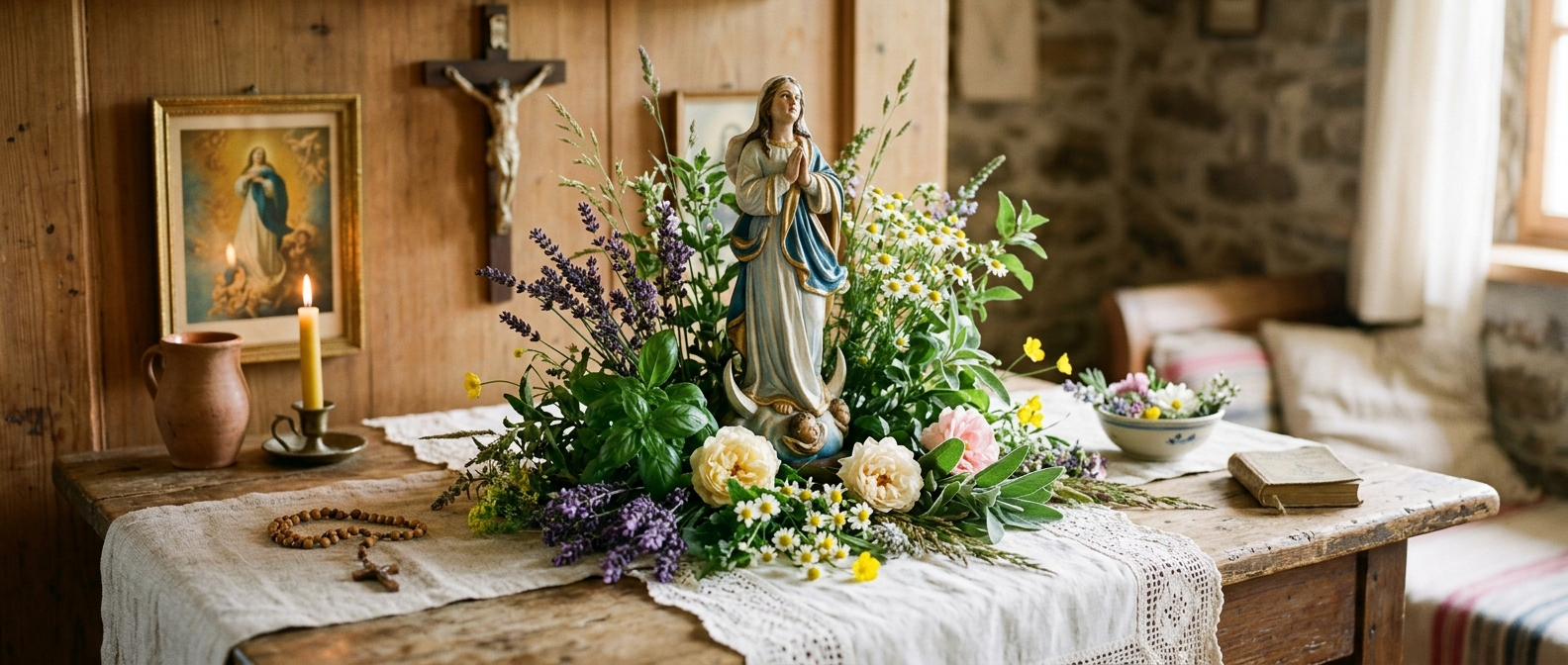
Every August 15th, millions of Catholic families go to Mass. It is one of our days of obligation.
(Except in the US, where it's not an obligation on a Saturday or Monday - but still, as a I heard a priest say last week, "Good Catholics still love Our Lady and will still try to be at Mass!")
And then after those Catholic families go to Mass, they go home, and the rest of the day looks like every other Saturday in August. Lunch happens. The kids scatter. The Holy Day of Obligation has been fulfilled. The feast of the Assumption - one of the six most important days on the Catholic calendar - has been observed in precisely the way the liturgical minimum requires, and no more.
I understand why this happens. Most of us were not taught what to do with feast days beyond Mass. The domestic traditions that once surrounded the great Catholic feasts did not survive the twentieth century's disruption of Catholic household culture, and most parishes do not have the bandwidth to teach them. The result is a generation of genuinely faithful Catholics who love the Assumption as a doctrine, attend Mass as it requires, and then spend the rest of the day without any shape given to it by the feast.
This post is about giving your household some of that shape.
Why the body matters
Before the traditions, a word about what we are celebrating. The Assumption is the Church's definitive statement that the body matters.
Mary was assumed body and soul into heaven. Not her soul alone - her body. The same body that said yes at the Annunciation, that carried the Word of God for nine months, that stood at the foot of the cross. That body is in heaven. It was not left behind. It was not treated as incidental to what mattered about Mary. It was taken up.
This has implications for every Catholic household, because every Catholic household is made of bodies. The dinner table where the family gathers is a place of bodies. The morning routine, the bedtime prayer, the weekend rhythm - all of it is embodied. The Assumption is the feast that says: this is not accidental to the life of faith. The body means something, it has a purpose, it is holy, and and its rhythms and its daily practices are the place where formation actually happens.
That is why a household observance of the Assumption matters, and why it is worth the trouble of building one. We are doing with our households what Mary's body did: making a home for what is holy.
The blessing of flowers and herbs
The oldest and most widespread household tradition for the Assumption is the blessing of summer flowers and herbs.
The tradition is rooted in the legend of the empty tomb. When the disciples opened Mary's tomb after her death, they found it filled with flowers - no body, only blossoms. In memory of this, the faithful have brought flowers and herbs to Mass on August 15th for centuries to receive a blessing. The blessed herbs and flowers are then kept in the home through the coming year, sometimes dried and placed near the family altar, sometimes woven into a wreath, sometimes tucked into a Bible or prayer book.
The specific herbs vary by region and culture. Lavender appears in most European traditions. Basil is central in the Italian tradition - and basil will appear again on September 14th for the Exaltation of the Holy Cross, where it carries its own story. Chamomile, rosemary, mint, and any summer wildflowers you have available are all traditional.
What you do with this at home:
- Bring a small bunch of summer herbs and flowers to Mass in your hands or in a basket
- After Mass, place them on the family altar
- Dry some to keep through the year
- When you light a candle near the altar in the months ahead, the herbs are a physical reminder of what you celebrated on this day
If your parish does not offer the blessing of herbs at Mass - many American parishes don't - you can bless them at home with a simple prayer. Place them near the altar, sprinkle them with holy water if you have it, and say: Lord, we bring you the fruits of this summer, which your creation has provided. May what we have received be a sign of what you promise - that what is given to you is not lost but transformed. Through Christ our Lord. Amen.
Flowers on the family altar
If the herbs and flowers are too much to organize, flowers alone are sufficient. This is the most accessible Assumption tradition and the most beautiful.
On August 15th, bring fresh flowers home and place them around Mary's image on your family altar. Let the children arrange them. This is the feast that honors her with flowers, and the children who help arrange them on the altar at eight and ten and twelve will remember the practice when they are adults with their own households.
If you do not have a family altar - a dedicated space where a cross or crucifix, an image of Mary, and a candle live together - this is the right time to make one. It does not need to be elaborate. A small table or shelf. A candle. Mary's image. A cross. The family altar is the domestic church's anchor. Everything else flows from it.
The Magnificat after Mass
After you return from Mass, pray the Magnificat together before or after the midday meal. This is Mary's own prayer - her response to the Annunciation, her song of what God does with the humble, the hungry, the lowly. It is the prayer most closely associated with her in the Scripture.
My soul proclaims the greatness of the Lord, my spirit rejoices in God my Savior...
Print it out if your family doesn't know it. Read it responsively - one person reads a line, everyone responds with the next. Let the children hear it. The Magnificat prayed on the Assumption is the household's way of entering into Mary's own response to what God has done - and what God is still doing, in every family that gathers in his name.
A feast day meal
The Assumption is a feast, and feasts are meant to involve food. This does not require anything elaborate.
In some European traditions, August 15th is marked with a meal that uses the first fruits of the summer harvest - whatever is coming ripe in the garden, whatever is best at the market. A salad of late summer tomatoes with fresh basil. A dish with the summer's corn or squash. The connection between the feast and the harvest is not accidental: August 15th falls at the height of summer abundance in most of Europe, and the tradition of honoring the harvest at the Assumption reflects the older agricultural Catholic calendar.
If you want something specific, make anything with fresh basil. The basil connects August 15th to September 14th (the Exaltation of the Cross), where the herb carries its own tradition and story. The family that cooks with fresh basil at the Assumption and again at the Exaltation has woven a thread between two feasts that most Catholic families have never connected.
One week later: the Queenship
The Assumption does not stand alone. One week later - always exactly one week - the feast of the Queenship of the Blessed Virgin Mary arrives on August 22nd. The Queenship is the Assumption's consequence: she was assumed, therefore she is Queen.
A simple observance on August 22nd: crown Mary's image. A wreath of flowers - made by the children out of whatever is available - placed on the statue or image on the family altar. Someone reads the fifth Glorious Mystery of the Rosary (the Coronation of Mary). The children lay the wreath on her head. The family says together: Mary, Queen of Heaven and earth, pray for us.
The children who do this on August 22nd are the children who will remember it when they are grown.
The shape of a Catholic August
What I am describing is not a program. It is not a checklist. It is a set of simple, beautiful, ancient practices that give the month of August a shape it does not otherwise have.
The Assumption on the 15th. Flowers on the altar. The Magnificat after Mass. A meal with the summer's best. The Queenship on the 22nd and a crown of flowers. These take perhaps thirty minutes of preparation and an hour of actual observance. And they give your household a Marian character across August that the children will feel even if they cannot name it.
The domestic church is built in these moments. Not in the dramatic ones. In the ordinary August Saturday when a family comes home from Mass, lays flowers on the altar, prays Mary's song together, and sits down to a meal that has been thought about. That is the domestic church. That is what we are building.
The Domus Formation daily content includes specific household practices for the Assumption and the Queenship, woven into every prayer path. Start a 7-day free trial at WeAreDomus.com and let your August take its liturgical shape.