
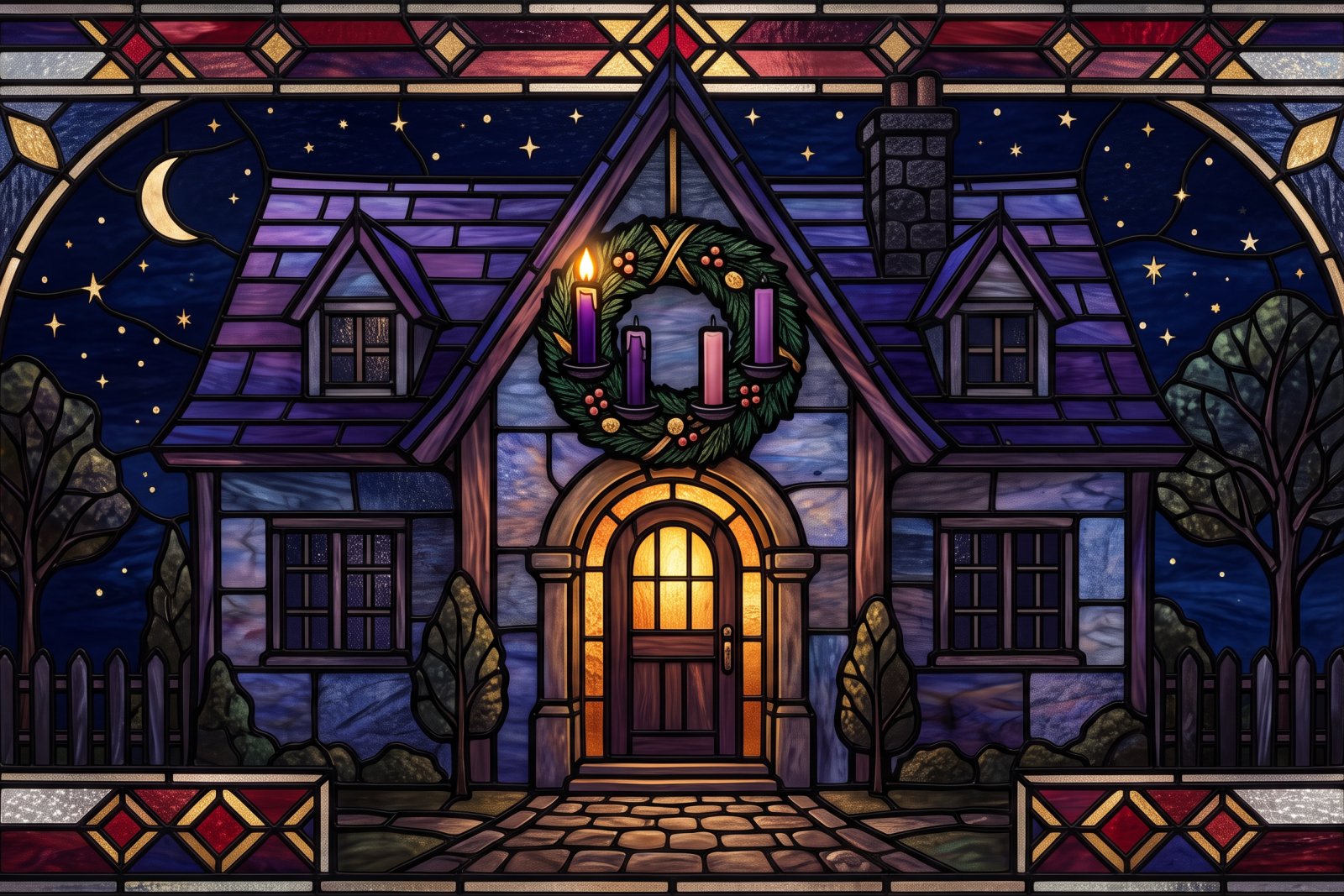
Advent starts this Sunday, and the first Gospel hands every household the same job. In Mark, Jesus tells his disciples about a man who goes away, leaves each servant his work, and tells the gatekeeper to keep watch, because nobody knows when the master will be back. "Watch," he says, and the rest of Advent is practice at doing it (Mark 13:33-37).
Domus is the Latin word for house, so we are calling this Advent "Keep the House." It runs four weeks and it starts quiet: walk the house at night, check the doors, notice who is under your roof. By the end it has one word left, "Come," and Psalm 80 carries that cry underneath the days all the way to December 24.
What Advent is, for anyone new to it
Advent means "coming," and the Church holds two comings in these weeks. One is Christ in Bethlehem. The other is Christ at the end of time, and the quiet daily coming between the two. Until December 16 the readings lean toward the second. On December 17 they turn toward Bethlehem, and the O Antiphons begin at evening prayer, one each evening through December 23.
Along the way, the Immaculate Conception falls on Tuesday, December 8, and Gaudete Sunday on December 13 breaks the purple with a rose candle and one word, "Rejoice." December's devotion on & Altar is the Immaculate Conception, so the month has a Marian center from the second week on.
The season is the same for everyone. What changes is who you are when you walk it. So each path on & Altar takes the same four weeks and speaks to a different person in the house.
Hearth & Altar - for families
Hearth is written for a table with children at it. Each day brings the readings, a short reflection, a Universal Prayer to say together, something to do, and a note for parents with one historic Catholic custom your family can pick up that day. The kind you can manage on a school night.
Here is how it goes. On the first Sunday it is the Advent wreath, which is newer than most families expect. A Lutheran pastor in Hamburg made the first one in 1839 to help the children count the days. On December 1 it is the Jesse tree. On December 5, since Sunday takes precedence over St. Nicholas, it is shoes by the door the night before. A small manger goes up in the second week and stays empty. On December 15 it is a family trip to Confession, announced the way you announce any other errand. In the last week the customs get closer to the door: family names read by candlelight on the 17th, the door frame blessed with holy water on the 18th, the last Jesse tree ornament hung on the 19th, and a candle in a jar carried outside at sunset on the 21st. On Christmas Eve, the youngest child places the figure.
Hogar y Altar and Ocaso y Altar - in Spanish
The Spanish paths walk the same four weeks, and they are written from Hispanic family tradition rather than translated from the English. Hogar has a tamalada before Christmas on December 2. On December 12 it tells the story of Our Lady of Guadalupe the way the tradition tells it. From December 16 through 24 it walks the nine nights of Las Posadas, with the children as pilgrims and an innkeeper who always opens the door at the end. Ocaso, for older readers, carries the same days in a slower register.
Iron & Altar - for men
Iron speaks to men as brothers, in a plain, formal voice. In this Gospel the man of the house is the one at the door, and Advent asks him to do the steward's work: guard what he has been given, and stay awake for the people in it. Each day gives a reading, a reflection, one challenge you can finish before bed, and a short prayer.
The challenges are specific. The first night, walk through your house the way the gatekeeper would and check every door. On December 2, write down seven things you have been trusted with at home. On December 6, finish one half-done thing: a repair, an apology, a Confession. On the Fridays, the offering thread continues, and in Advent we ask you to name the person you are offering the day's small sacrifice for.
Vessel & Altar - for women
Vessel is written to women as sisters, and it runs on recognition and receiving, which are the two things Advent asks of Mary before anything else happens. She is greeted, she recognizes what is being said to her, and she receives it. The path follows that order, and on December 8 it stops to look at how completely she was prepared. The challenges are small on purpose. Accept something without paying it back. Say only "Thank you." On the third Sunday, write down one promise of God you are living on without having seen it kept.
Eventide & Altar - for elders
Eventide is named for the eventide of life, not for a time of day, and most of its readers pray it in the morning anyway. Elders know Advent from the inside. They have waited at hospital windows, at kitchen tables, and by the mailbox. Each day brings the readings, a reflection written to be read aloud slowly, the Rosary, the prayers of the faithful, and something to do before the day is over. Call someone you have stopped speaking to. Say the names of three people who came before you. Tell a story you have never told. On Christmas Eve, read Zechariah's song aloud at a window.
Young Disciples - for teens
Young Disciples is for teens, thirteen and up. It is a short daily with straight talk about the readings and one challenge that rotates between thinking, praying, and reaching toward another person, so no two days in a row ask for the same thing. Each week has its own question. What am I actually waiting for? Who am I supposed to point to? Is this the one, or should I keep looking? And in the last week, will I say yes?
For deacons and parishes
Deacons have a path of their own, with a reflection written for the diaconal heart. Parishes get a set their pastors and lectors can pick up and use: the theme, liturgical notes, a Kyrie, a Universal Prayer in English and Spanish, and a homily starter.
The last week
Everything above builds to the final stretch. From December 16 there are nine nights of prayer leading to Christmas Eve. From December 17 there is one O Antiphon each evening, seven short invocations that the Church has sung for well over a thousand years, each naming Christ by a title from the prophets. Read in reverse, the first letters of the titles spell a Latin phrase, and it is a promise. On December 23, Hearth families set seven letters on the table, and the youngest child turns the row around to read it. We will leave it there for now.
You do not need all of them
Pick the paths that match who is under your roof. Each takes about five to ten minutes a day, and Advent is only four weeks, so you have not missed anything if you start on the second Sunday. The first seven days are free, with no credit card.
Pray daily, with the Church. Start at andaltar.com.